ManufactureCT Scholarship
Anthony Murray
Bullard Havens Technical High School
Class of 2026



Anthony Murray
Bullard Havens Technical High School
Class of 2026

Angela Riano
Kaynor Technical High School
Class of 2026
Johan Rasid
University High School of Science & Engineering
Class of 2026

Paolo Cultrera
Berlin High School
Class of 2026

Abigail Rogucki
Emmett O’Brien Technical High School
Class of 2026
Guest Blogpost Contributed by SphereGen
Author: Prakaithip Romanow, Director, Manufacturing AI | Contact E Mail
Connecticut has long been a powerhouse of American manufacturing. With more than 4,500 manufacturers, a highly skilled workforce, and deep expertise in aerospace, defense, medical devices, and precision machining, the state is uniquely positioned to benefit from artificial intelligence (AI) and AI-based technologies such as intelligent automation.
Data source: https://www.ctdata.org/interactive-data-projects
And yet, while most manufacturers understand the need to start now, a majority are still sitting on the sidelines.
In a recent Connecticut manufacturing report, “Only 27% of manufacturers reported integrating artificial intelligence into their operations, ….. Among those not adopting AI, 80% indicated they were unsure how to incorporate it, 14% expressed concerns about privacy, and 6% cited liability risks.”
Manufacturers are not alone in identifying that their biggest barrier to adopting AI and intelligent automation is simply not knowing where to start. The good news is that you don’t have to start big to deliver a meaningful return on investment (ROI). This article explores how starting small now with AI can help manufacturers gain traction, scale responsibly, and begin to recognize returns beyond cost savings—specifically through the benefit of reclaimed capacity.
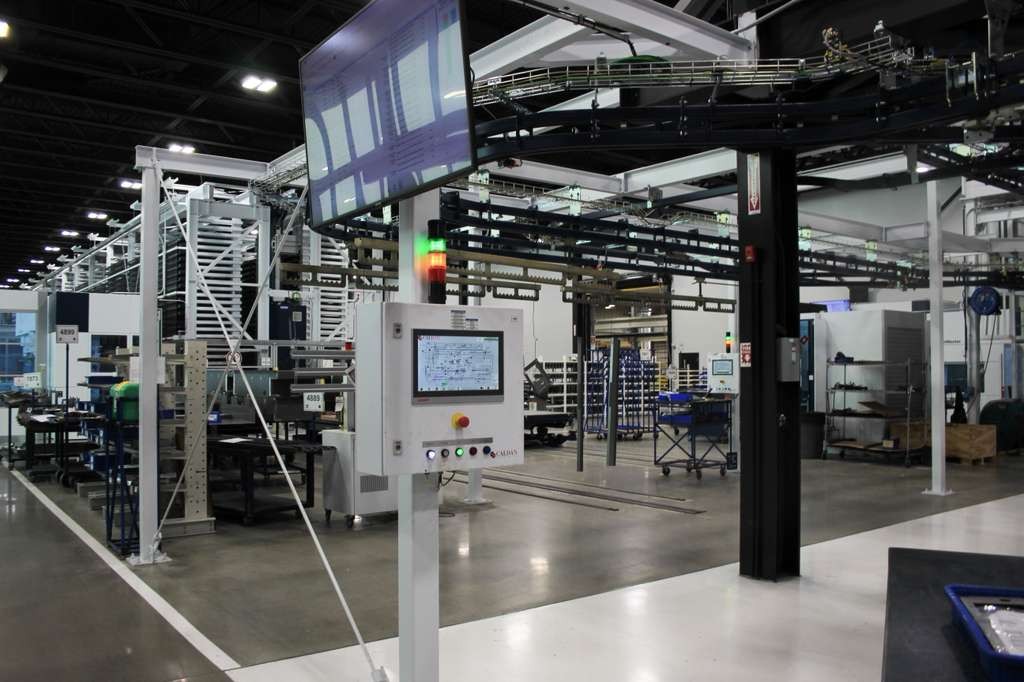
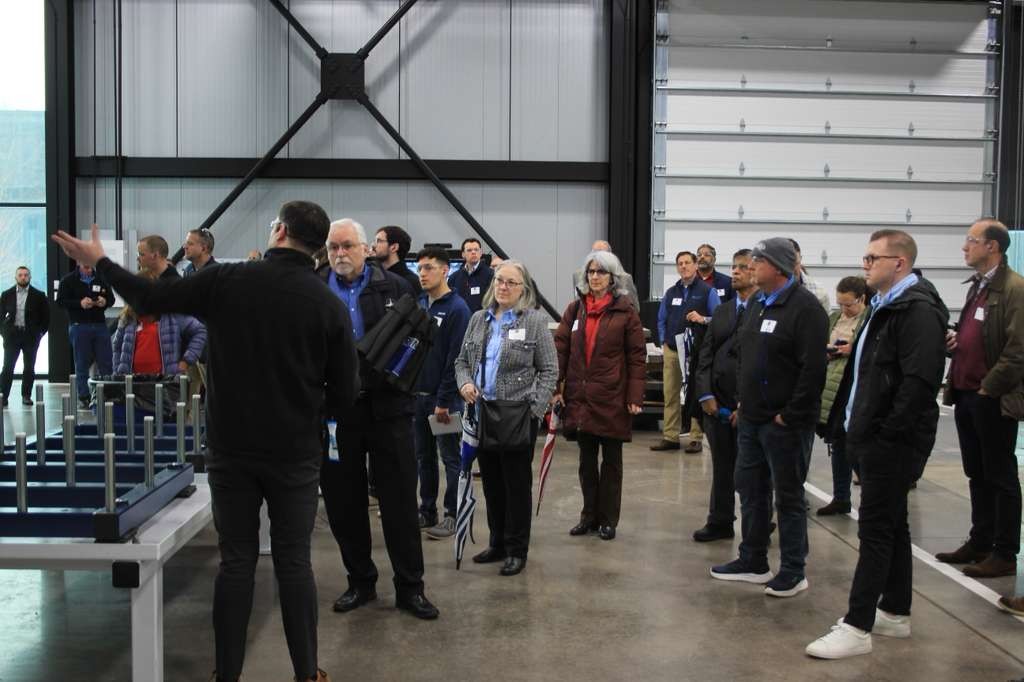
MCT members include smart manufacturers like TRUMPF in Wallingford. Images are from a Feb 2026 tour we organized.
One of the biggest misconceptions about AI is that beginning requires a large initial investment or a complete digital overhaul. In reality, the most successful AI journeys in manufacturing start small, with a focused proof of concept (POC) tied to a real business problem.
AI and Intelligent Automation work particularly well in administrative areas where data entry, document handling and reporting comprise the bulk of daily work. A few examples of AI POCs include:
A well-designed POC reduces risk by limiting scope and exposure, delivers a measurable ROI in a short period of time, and builds confidence in the technology across the organization.
Even though manufacturers should start small with a POC, it is still critical to have a plan in place to operationalize that proof of concept and apply the concept to other areas of the business. This is how AI initiatives scale.
When a POC fails, it is usually not because the technology doesn’t work. More often, organizations move faster on experimentation than on building the foundations needed for long-term success. Business and technology teams must work together in a truly integrated way to make a plan, execute that plan, and analyze results.
To build a successful AI POC and ensure that its concepts scale across the business, manufacturers should consider the following guidelines:
Scaling success depends on establishing a consistent, repeatable approach to identifying value, testing effectively, and applying proven methods across multiple areas within the organization.
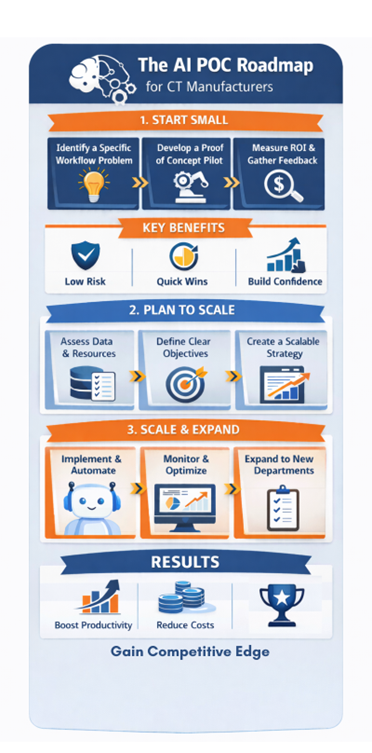
Infographic created by Red Rock Branding with AI assist
The primary benefits of early AI and intelligent Automation investments are immediate productivity gains. In manufacturing, these typically appear as incremental gains, including:
While these gains may look modest on paper, they compound quickly over time. When AI removes low-value, repetitive work, it doesn’t simply save time—it frees experienced people to focus on higher-impact activities. This is where ROI shifts from incremental to exponential. Instead of hiring additional staff, manufacturers unlock productivity from the talent they already have by reclaiming capacity.
Those reclaimed hours do not disappear. ROI accelerates as they are reinvested into process improvement initiatives, supplier and quality issue resolution, throughput and capacity optimization, and mentoring front line leaders.
The value of AI is not limited to cost savings—it is driven by better decisions, made faster, by the right people.
AI done right does not replace experience—it amplifies it by gaining more capacity from the talent manufacturers already trust.
Most Connecticut manufacturers are small to mid-sized organizations, and that is an advantage. Smaller teams can move faster, test ideas more quickly, and adapt solutions without layers of complexity. AI adoption today is no longer about who has the biggest budget—it is about who starts with the clearest focus.
Manufacturers that begin now, with a disciplined POC and a clear path to scale, will be better positioned to:
As economist Richard E. Baldwin notes, “AI won’t take your job. It’s somebody using AI that will.”
The question is not whether AI will impact Connecticut manufacturing—it is who will move first, and who will be forced to catch up. When you are ready to take the first step, remember to 1) start small 2) stay focused and 3) build toward scale.
***
Fortunately, Connecticut manufacturers are not starting from scratch. A strong network of state, industry, and legal resources exists to support responsible AI adoption. Here are some steps you can take to plug into them.
Review the Connecticut Manufacturing Strategic Plan – the state’s long-term vision for strengthening competitiveness, workforce development, and advanced technology adoption.
Explore the Manufacturing Innovation Fund (MIF) – offering grants and funding opportunities for modernization and technology initiatives.
Connect with the Connecticut Center for Advanced Technology (CCAT) – a New Haven–based, Affiliate Member of MCT, providing hands-on support, smart manufacturing guidance, and workforce training.
Understand evolving legal considerations in AI hiring – read “AI in Hiring — The Laws Are Coming,” a Connecticut-focused overview of how AI tools intersect with employment law and recruitment practices.

SphereGen is driving digital transformation by making technology relevant.
SphereGen is a custom solutions provider that specializes in cloud-based applications, AI, Intelligent Automation, and Extended Reality (AR/VR/MR). SphereGen offers full-stack custom application development to help customers employ innovative technology to solve business problems. They are a recent new member. You can reach the author of this article for feedback HERE
ManufactureCT is pleased to invite member companies who are subject matter experts to weigh in on timely topics that are relevant and important to the Connecticut manufacturing community. A complete directory of our valued members is searchable on our website by company name, keyword, and/or category.